
How Solo.io Is Building AI-Native API Gateways for Enterprises
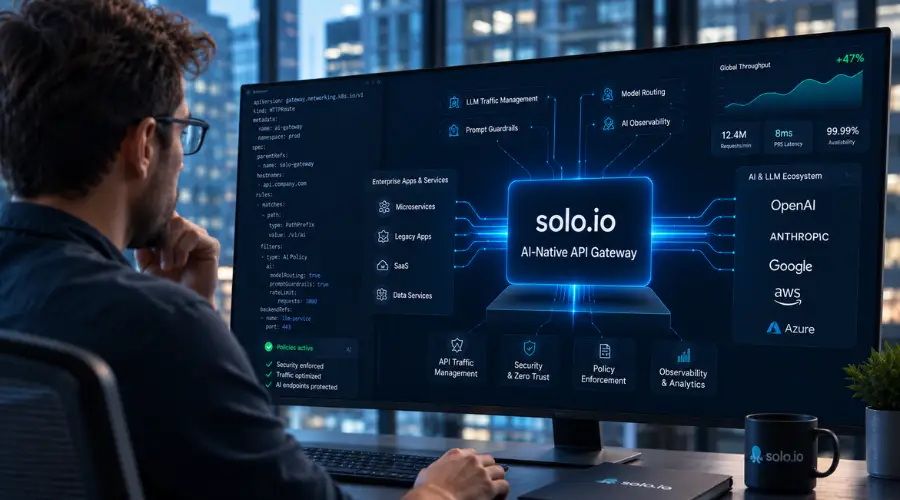
Enterprise AI applications are starting to look less like ordinary web applications and more like distributed decision systems. A single user request may pass through an application, reach a large language model, call a tool, retrieve business data, stream a partial answer, and trigger another API call before the response is complete.
That changes what platform teams need from the gateway layer.
Traditional API gateways were built to control access to services, route traffic, apply policies, and collect logs. Those jobs still matter. AI traffic adds new problems: token-based costs, prompt injection risk, sensitive data exposure, provider-specific APIs, streaming responses, model failover, and agents that can call tools on behalf of users.
Solo.io’s Gloo AI Gateway is aimed at this problem. Instead of asking every application team to wire its own model credentials, provider integrations, prompt controls, and usage monitoring, Solo.io puts those controls into the gateway layer. The goal is to give enterprises a managed path for AI traffic before it reaches external or internal models.
Why traditional API gateways start to strain
Standard API gateways excel at managing predictable traffic, but AI workloads are different. Between handling sensitive prompts, managing fluctuating token costs, and supporting complex agents, traditional controls simply can’t keep up. To scale safely, platform teams need an intelligent gateway layer that handles model-specific security, access, and observability without bottlenecking development.
How Gloo AI Gateway fits into enterprise AI platforms
Solo.io builds Gloo AI Gateway on top of Gloo Gateway, with AI-specific functions exposed through gateway policies. It is designed for enterprises that want centralized control over access to LLM providers while still letting application teams build AI features without embedding every provider detail in their code.
One common problem is provider sprawl. A team may begin with OpenAI, then test Anthropic, Mistral, Gemini, Azure OpenAI, or Vertex AI. Each provider has its own APIs, authentication model, request format, streaming behavior, and operational quirks.
Gloo AI Gateway gives developers a unified interface for consuming AI services from multiple LLM providers. That does not remove the need to understand model behavior, but it reduces how much provider-specific plumbing has to live inside each application.
This matters because model choice is no longer a one-time architecture decision. Some workloads may need a lower-cost model. Others may need stronger reasoning, faster output, a self-hosted option, or stricter data controls. A gateway that can route and govern requests across models gives platform teams a safer way to support that variation.
Securing AI traffic before it reaches the model
Strong security means controlling exactly who can access your AI. Gloo AI Gateway centralizes authentication, letting you easily restrict access by user, role, or team. It also adds a critical layer of protection by using ‘prompt guards’ to scan inputs and outputs for sensitive data or policy violations. Instead of forcing every development team to build their own security filters, Gloo handles these checks automatically at the gateway level.
Managing cost, usage, and reliability
Managing LLM costs and reliability is tricky because standard request-based rate limits don’t track token usage, which varies wildly between calls. Gloo AI Gateway solves this with token-aware limits, letting you set budgets by user or team to prevent surprise bills. It also boosts reliability: if a model goes down, Gloo automatically routes traffic to a fallback provider. While this simplifies traffic control, remember that different models still behave differently—so while Gloo handles the routing, your team still needs to ensure your apps are tested for those model-specific quirks.
Observability for model-heavy systems
Standard HTTP metrics won’t cut it for AI. Teams need a deeper look into which models are being used, provider performance, and exact token consumption. Without this visibility, AI usage quickly turns into “shadow IT,” leaving organizations in the dark about cost and risk.
Gloo AI Gateway simplifies this by tracking prompt and completion tokens out of the box. You can even add custom labels to break down usage by team or department, making it easy to see who is spending what.
This shared data keeps everyone aligned: finance can manage budgets, security can audit access, and developers can optimize for latency and reliability. It’s the only way to scale AI while keeping full control of the platform.
Multi-model AI needs consistent control
AI tech rarely stays tied to a single model or provider—different teams have different priorities, from cost and quality to strict data privacy. Left unchecked, this creates a ‘patchwork’ of scattered, hard-to-govern integrations. Gloo AI Gateway fixes this by centralizing critical controls like access, token limits, and failover. It gives platform teams the visibility to easily manage usage, spend, and security, rather than chasing them down across messy, app-level code.
A practical gateway layer for enterprise AI
AI adoption is pushing API gateways into a new role. They are becoming control points for model access, agent traffic, prompt policy, usage reporting, and provider choice.
Solo.io’s Gloo AI Gateway reflects that shift. It takes familiar gateway patterns such as routing, authentication, authorization, rate limiting, and observability, then adapts them for LLM traffic. The product does not remove the need for model evaluation, AI risk management, or application-level testing. It gives platform teams a place to enforce shared rules while developers continue building AI applications.
For enterprises, that is the value of an AI-native gateway. It gives AI workloads a managed path into production, with enough control to reduce sprawl and enough flexibility to support more than one model, provider, or deployment pattern.












Get involved!
Comments